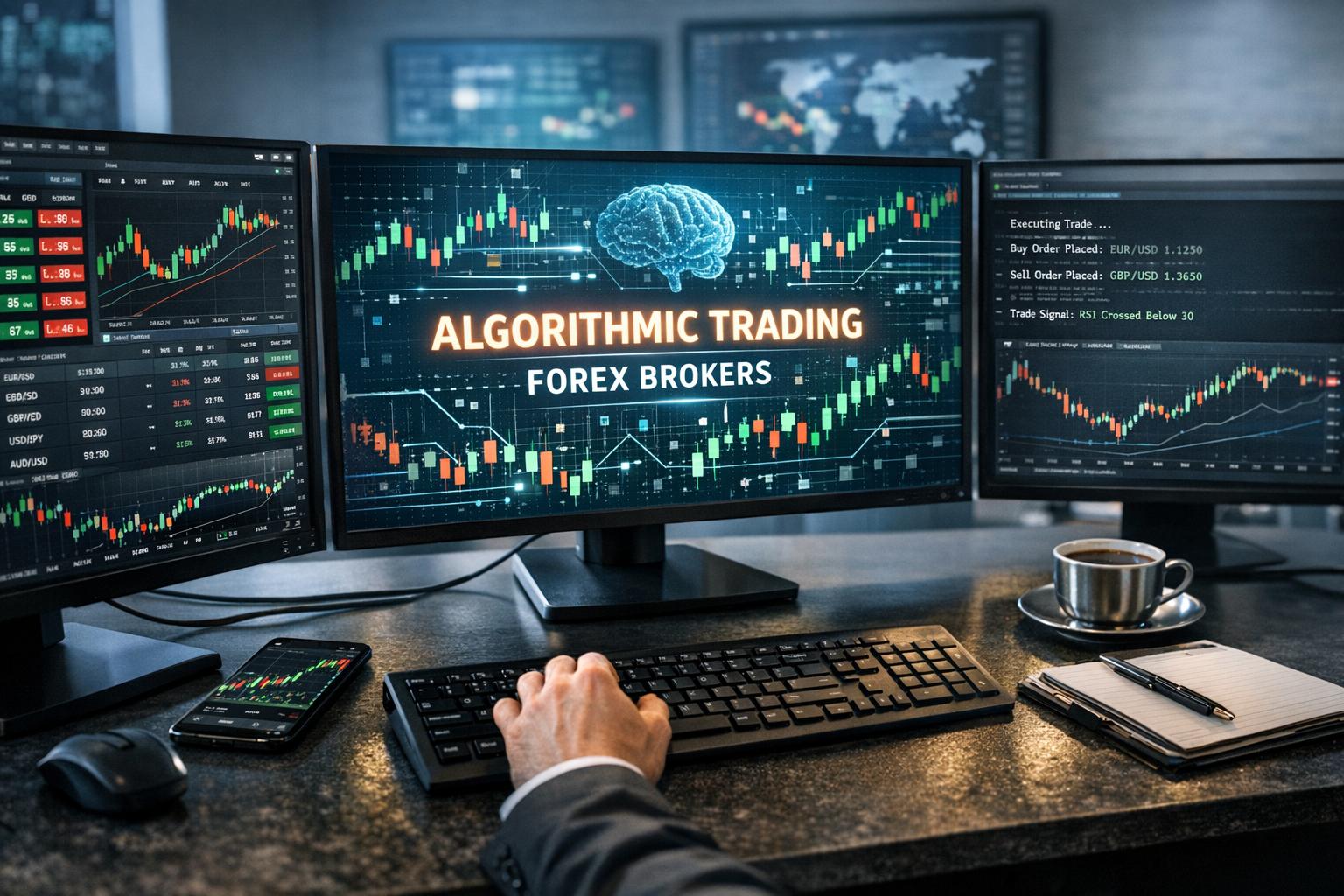
Algorithmic Trading Brokers Forex brokers
Algorithmic trading has become a central component of modern financial markets. Once limited to large hedge funds and institutional traders, automated strategies are now accessible to individual traders through online platforms. In the foreign exchange market, the combination of high liquidity, continuous trading hours, and technological accessibility has made forex one of the primary arenas for algorithmic strategies. Understanding how algorithmic trading brokers operate and how forex brokers support automated systems is essential for traders seeking efficiency, precision, and scalability.
The global forex market processes trillions of dollars in daily transactions. This scale creates an environment where price movements occur continuously, driven by macroeconomic data, central bank policy, cross-border investment flows, and speculative activity. Within this setting, algorithmic systems can monitor price changes across multiple currency pairs and execute trades based on predefined logic without manual intervention. The broker serves as the structural gateway between the trader’s system and the broader liquidity network.
Understanding Algorithmic Trading
Algorithmic trading refers to the use of computer programs that follow predefined instructions to place trades automatically. These instructions may be based on price, volume, timing, technical indicators, statistical relationships, or combinations of structured conditions. Instead of manually interpreting charts and submitting orders, traders design algorithms that analyze data inputs and trigger transactions according to specific rules.
Algorithms range from relatively simple rule-based systems to complex quantitative models incorporating statistical inference or machine learning. A basic example might involve opening a position when a short-term moving average crosses above a long-term average and closing it under predetermined risk constraints. More advanced systems can integrate volatility filters, correlation matrices, or macroeconomic event detection.
In forex markets, algorithms can monitor numerous currency pairs simultaneously and react to price movements within milliseconds. The primary objectives are consistency, repeatability, and execution speed. Automated systems remove discretionary judgment from the order placement process and can operate continuously in a market that trades 24 hours a day during the business week. This uninterrupted operation allows strategies to respond to developments in Asia, Europe, and North America without human presence at each session.
Foreign Exchange Market Structure
The forex market differs from centralized exchanges such as equity markets because it operates primarily over-the-counter. Transactions occur electronically between banks, financial institutions, corporations, and brokers. Prices are formed through competitive bidding and asking within an interconnected global network.
For retail traders, access to this network is mediated by a broker. The broker aggregates quotes from liquidity providers, which may include large banks, non-bank market makers, and electronic liquidity venues. When an algorithm sends an order, it is routed through the broker’s infrastructure toward these counterparties. The structure of this routing process directly influences execution quality, spreads, and fill reliability.
Currency pairs are quoted in terms of a base currency and a quote currency. Price changes are typically measured in pips, and even small pip movements can represent meaningful gains or losses depending on position size. For algorithmic systems operating with high trade frequency, incremental differences in spreads or slippage accumulate over time and substantially affect net results.
Role of Brokers in Algorithmic Forex Trading
A forex broker acts as the intermediary between retail participants and broader liquidity sources. For algorithmic traders, broker capabilities extend beyond basic order execution. Infrastructure quality, server stability, platform compatibility, and cost transparency directly influence automated performance.
Automated systems rely on uninterrupted connectivity. When a strategy detects a qualifying trade condition, the instruction must travel from the trader’s platform or server to the broker’s matching engine and then to liquidity providers. Delays at any stage may alter execution prices. Therefore, brokers that support algorithmic trading invest in optimized routing systems and co-located data centers.
Many brokers provide technical environments tailored to automation, including support for scripting languages, backtesting engines, and integrated deployment tools. They may also offer log data that allows traders to audit execution times, order rejections, and slippage statistics. For systematic traders, this operational transparency is central to strategy evaluation.
Execution Models and Their Impact
The execution model adopted by a broker significantly shapes algorithmic outcomes. Forex brokers typically operate under market maker structures or agency-style models such as STP (Straight Through Processing) and ECN (Electronic Communication Network).
Market makers may provide liquidity internally by taking the opposite side of client trades or by managing aggregate exposure through hedging arrangements. In such cases, spreads may be fixed or semi-fixed. Predictable spreads can simplify cost modeling for algorithms, but execution policies vary between firms and may include requotes under fast market conditions.
STP and ECN models are designed to pass orders directly to external liquidity providers. Prices are commonly variable and reflect underlying market conditions. Traders may observe narrower spreads during high liquidity periods and wider spreads during volatile or low-volume intervals. Commission structures are often explicit, separating bid-ask spreads from brokerage fees.
For strategies such as scalping or short-term mean reversion, execution speed and slippage tolerance are central metrics. If an algorithm depends on capturing small price changes, any delay between order submission and confirmation may erode expected statistical advantages. Testing execution under live conditions helps determine whether a broker’s model aligns with strategy assumptions.
Order Types and Routing Mechanics
Algorithmic systems utilize a range of order types, including market orders, limit orders, stop orders, and stop-limit variants. The practical behavior of these orders can differ depending on broker policies and liquidity conditions.
A market order seeks immediate execution at the best available price. In fast-moving markets, the fill price may deviate from the quoted price at submission, resulting in slippage. Limit orders specify a maximum or minimum acceptable price. While they provide price control, they do not guarantee execution if the market does not trade at the specified level.
Routing logic inside the broker’s system determines how orders interact with liquidity pools. Some brokers aggregate multiple price feeds and execute against the best composite quote. Others use internal crossing systems before routing externally. For algorithmic traders, understanding these mechanics helps calibrate expectations concerning fill probability and latency.
Trading Platforms for Algorithmic Forex Strategies
Brokers serving algorithmic clients commonly support platforms such as MetaTrader 4 (MT4), MetaTrader 5 (MT5), and cTrader. These platforms incorporate development environments that allow traders to code, test, and implement automated systems within a unified interface.
MT4 and MT5 rely on proprietary languages known as MQL4 and MQL5. Developers create automated scripts referred to as Expert Advisors (EAs), which can analyze indicators, generate trading signals, and manage open positions. MT5 extends functionality by supporting multiple asset classes and offering multi-threaded strategy testing, which accelerates historical simulations.
cTrader enables automation through C#, a widely used programming language. This compatibility may appeal to individuals with formal software development backgrounds. Broader language accessibility can facilitate integration with external analytics libraries or proprietary data processing systems.
Platform reliability, update frequency, and compatibility with broker server architecture all influence operational stability. Minor software discrepancies between demo and live environments can affect order handling, underscoring the need for environment-specific testing.
Importance of Latency and Infrastructure
Latency represents the time delay between an order’s initiation and its execution confirmation. In algorithmic forex trading, latency management can determine whether a strategy performs according to its historical simulations. Measured in milliseconds, latency reflects physical server distance, network stability, and internal processing efficiency.
Brokers often maintain data centers near established financial hubs such as London, New York, or Tokyo. Proximity to liquidity sources reduces transmission delays. Some traders deploy algorithms on Virtual Private Servers (VPS) located within the same facilities, thereby shortening communication pathways between trading software and broker servers.
Continuous uptime is equally important. Automated strategies typically operate without interruption during market hours. A VPS environment ensures system continuity in the event of local hardware failure or internet outages. Brokers may provide integrated VPS services or certify third-party hosting providers compatible with their systems.
Costs and Pricing Structures
Transaction costs form a measurable component of algorithmic performance. Forex broker pricing typically includes spreads, commissions, and swap or rollover charges for positions held overnight. For high-frequency strategies, cost modeling must incorporate each of these elements.
Some brokers advertise commission-free trading with wider bid-ask spreads. Others offer raw spreads closer to interbank levels, supplemented by a fixed commission per standard lot traded. For algorithms executing frequent transactions, a narrow raw spread combined with clear commission disclosure may offer predictable cost accounting.
Swap rates vary according to interest rate differentials between currencies. Although many algorithmic strategies are intraday, others may hold positions for extended periods and incur overnight financing adjustments. Accurate backtesting requires inclusion of historical swap data where applicable.
Backtesting and Data Integrity
Historical testing allows traders to evaluate strategy logic over prior market conditions. Brokers often supply historical price data for use within platform testing modules. The precision of this data influences simulation reliability.
Tick-level data provides granular insights into intraday price fluctuations. When spreads are variable, historical modeling should reflect realistic bid-ask dynamics rather than simplified constant spreads. Discrepancies between historical simulations and live execution commonly stem from data simplifications or unmodeled slippage.
Forward testing on demo accounts offers an intermediate validation step. However, demo environments may not always replicate real-time liquidity constraints. Small-scale live deployment helps bridge the gap between theoretical modeling and actual market interaction.
Regulation and Compliance Considerations
Regulatory oversight contributes to operational stability and client fund protection. Authorities such as the Financial Conduct Authority (FCA), the Australian Securities and Investments Commission (ASIC), and the Commodity Futures Trading Commission (CFTC) impose standards concerning capital requirements and client asset segregation.
Algorithmic traders deploying significant capital may prioritize brokers subject to well-established regulatory frameworks. Compliance structures typically include periodic audits, reporting obligations, and dispute resolution mechanisms. Counterparty risk cannot be entirely eliminated, but regulated environments establish defined accountability standards.
Jurisdictional regulations may also influence leverage limits, margin rules, and permissible trading practices. System design must align not only with broker policies but also with regional regulatory requirements.
Risk Management in Automated Forex Trading
Automation does not remove financial risk. On the contrary, rapid execution can accelerate losses if error handling and protective controls are insufficient. Embedding risk management parameters directly within algorithm logic is fundamental.
Risk controls may include predefined stop-loss thresholds, equity-based drawdown limits, and volatility-adjusted position sizing. Brokers enforce margin requirements that determine the minimum capital necessary to maintain open positions. If equity falls below specified levels, automatic liquidation procedures may trigger.
Extraordinary market events, such as central bank announcements or geopolitical disruptions, can produce gap movements and temporary liquidity shortages. Algorithms must account for such conditions either by suspending trading during scheduled high-impact events or by widening internal risk buffers.
Liquidity and Market Depth
Liquidity reflects the market’s capacity to absorb trade volume without substantial price distortion. Major currency pairs tend to display deep liquidity pools during active trading hours. However, conditions can vary based on session overlap and macroeconomic developments.
Some brokers provide access to Level II pricing, revealing multiple tiers of bid and ask quotes. While not all retail platforms display full order book data, aggregated depth indicators can assist strategies that consider order size relative to available liquidity.
For larger trade volumes, partial fills or multi-level execution may occur. Algorithms designed for scalability should incorporate checks for fill confirmation and average price calculation to maintain accurate performance accounting.
Security and Operational Stability
Digital security measures protect client data and transaction integrity. Encryption protocols, multi-factor authentication, and account verification standards contribute to safeguarding trading accounts. For continuously running automated systems, maintaining secure login credentials and protected server access is essential.
Operational stability involves server uptime, redundancy planning, and maintenance scheduling. Reputable brokers communicate planned downtime in advance and employ backup systems to mitigate disruption. Automated traders may use monitoring scripts that generate alerts if trading halts unexpectedly or if order execution deviates from predefined parameters.
Scalability and Multi-Asset Expansion
Algorithmic trading systems can be scaled by increasing position sizes, expanding to additional currency pairs, or diversifying into related instruments. Brokers offering a broad selection of tradable products enable systematic deployment across multiple markets within a single account structure.
Contracts for difference (CFDs) on indices, commodities, or cryptocurrencies often share the same trading platforms used for forex. Although infrastructure similarities simplify expansion, each asset class carries distinct liquidity patterns and cost profiles. Algorithm modifications may be necessary before extending a forex-based model to alternative instruments.
Technological Development and API Integration
Beyond retail trading platforms, some brokers provide Application Programming Interfaces (APIs) such as REST or FIX connections. These interfaces allow direct communication between proprietary trading systems and broker servers without relying solely on graphical platforms.
API-based trading can reduce overhead latency and permit advanced customization, including direct order book analysis or integration with external analytics engines. Institutional participants frequently employ such solutions, but advanced retail traders increasingly access similar capabilities.
The development of cloud computing environments and distributed processing frameworks supports complex quantitative research. While the broker’s role remains centered on execution and clearing, compatibility with external systems enhances flexibility for technologically sophisticated traders.
Evaluating Broker Transparency
Transparency encompasses pricing disclosure, order execution metrics, and policy clarity. Brokers may publish average execution speeds, slippage statistics, and rejection rates. Such quantitative disclosures assist traders in comparing operational efficiency.
Clear explanations of margin calculations, rollover policies, and order handling procedures reduce uncertainty. Algorithmic strategies built on precise parameters depend on consistent broker behavior. Before significant capital allocation, traders often conduct limited live trials to observe execution patterns under normal market conditions.
Conclusion
Algorithmic trading within the forex market combines systematic strategy design with broker-provided infrastructure. Execution models, pricing structures, platform compatibility, server location, and regulatory standing collectively shape trading results. The broker operates as both technological facilitator and market intermediary, influencing how efficiently orders transition from code to execution.
Careful evaluation of infrastructure quality, transaction costs, data integrity, and compliance standards enables traders to align automated systems with appropriate brokerage services. While technological advancement has expanded access to tools once associated primarily with institutional finance, disciplined due diligence remains necessary.
Foreign exchange markets are inherently dynamic, and no system or broker configuration guarantees consistent profitability. Nevertheless, a structured understanding of how algorithmic strategies interface with forex brokerage environments supports informed decision-making and more accurate performance assessment within automated trading frameworks.