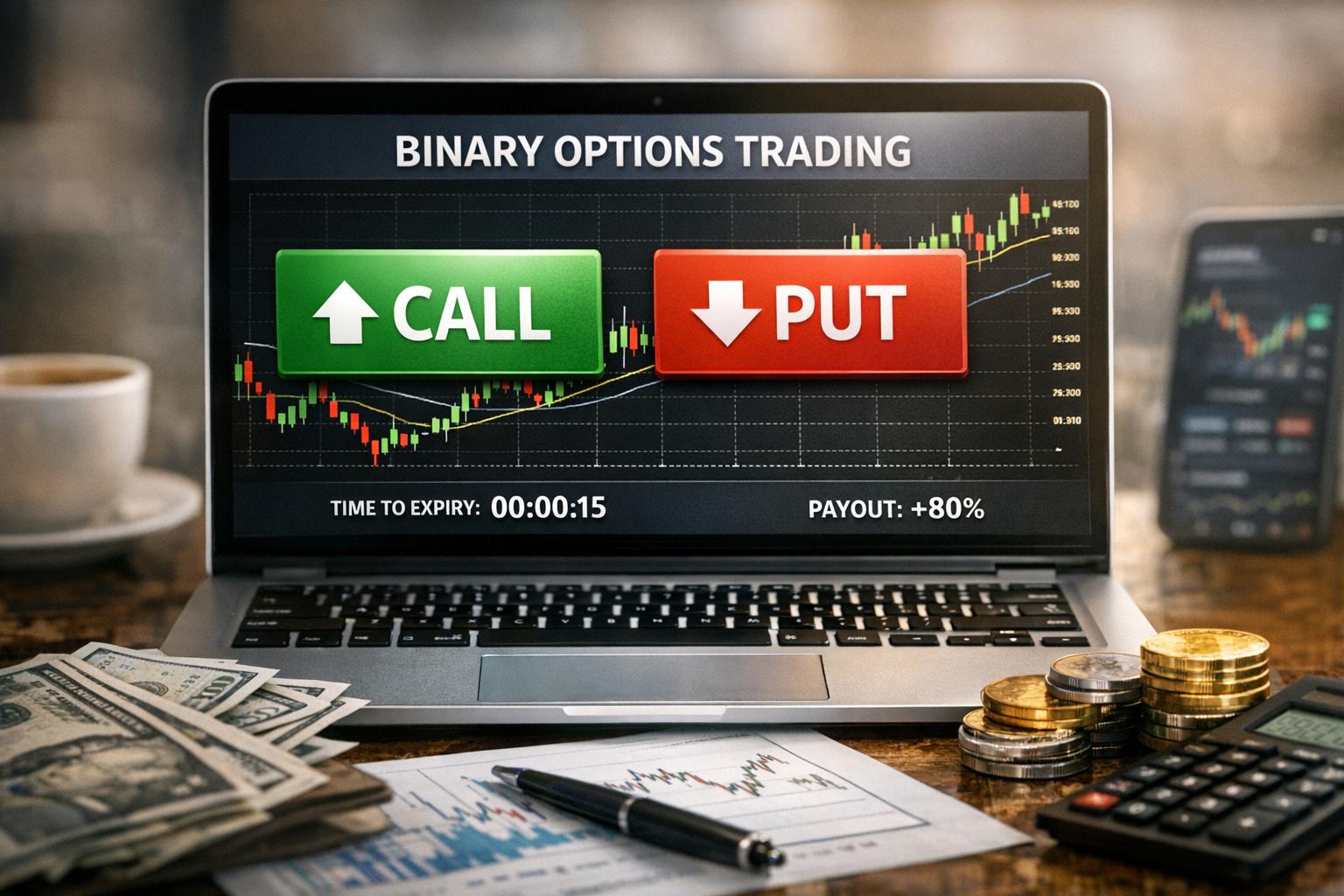
Binary options
Binary options are a type of financial derivative that allow traders to speculate on the short-term price movement of an underlying asset. Unlike traditional trading methods, where profits and losses vary according to how far the market moves, binary options have a fixed payout structure. The outcome is typically limited to two possibilities: a predetermined return if the option expires “in the money,” or a total loss of the invested amount if it expires “out of the money.” This simplified payoff model has attracted both retail traders and regulatory scrutiny over the past two decades.
Definition and Basic Structure
A binary option is a contract based on the price movement of an underlying asset such as a currency pair, stock, commodity, or stock index. The trader selects a direction—usually whether the price will be above or below a certain level at a specified expiration time. If the prediction is correct at expiration, the trader receives a fixed payout. If the prediction is incorrect, the trader loses the entire stake.
The term binary refers to the two possible outcomes. There is no partial gain or scaled loss. The contract settles in an all-or-nothing manner. For example, a broker may offer an 80 percent payout on a successful trade. If a trader invests $100 and the option expires in the money, they receive $180 in total, reflecting the original $100 plus $80 profit. If it expires out of the money, the trader loses the $100 staked on the contract.
This clearly defined risk and reward framework differentiates binary options from margin-based products such as leveraged foreign exchange or contracts for difference. In those markets, losses may exceed the initial deposit if risk controls are not applied. In contrast, binary options cap the maximum loss at the upfront investment, although repeated trades can cumulatively result in substantial capital erosion.
Pricing Mechanics and Contract Valuation
Although the retail presentation of binary options appears simple, the pricing mechanics are rooted in probability theory. Each binary option reflects the estimated probability that a specified condition will be met at expiration. In regulated environments, this probability is often derived from models related to those used in traditional options pricing, adjusted to reflect the digital payoff structure.
In an exchange-traded setting, a binary option may be quoted on a scale from 0 to 100. The price represents the market’s implied probability of settlement in the money. For instance, a contract trading at 65 implies a 65 percent perceived probability that the condition will be satisfied. If the event occurs, the contract settles at 100; if not, it settles at 0. Traders can buy or sell such contracts prior to expiration, realizing gains or losses based on changes in market expectations.
On many over-the-counter retail platforms, pricing transparency is more limited. The broker may set both the implied probability and the payout ratio. The payout often embeds a margin that provides the broker with a statistical advantage over time. As a result, understanding the relationship between payout percentage and required win rate is critical for evaluating the long-term feasibility of a trading approach.
Historical Development
Binary options are conceptually related to digital options long used in institutional finance. These instruments paid a fixed amount if a specific condition was met, typically employed in structured products and risk management strategies. The adaptation of this concept for retail markets accelerated in the early 2000s with the growth of internet-based trading platforms.
In 2008, regulated binary options began trading in the United States through approved exchanges. These contracts were standardized, centrally cleared, and supervised by regulatory authorities. At the same time, numerous offshore platforms emerged offering simplified versions directly to retail traders worldwide. These entities often operated outside major regulatory jurisdictions, leading to significant differences in transparency, pricing integrity, and dispute resolution mechanisms.
The rapid international expansion of online platforms drew attention from financial regulators. Concerns arose regarding misleading marketing practices, conflicts of interest, and insufficient disclosure of risks. Over subsequent years, multiple jurisdictions reviewed or restricted retail access to binary options products.
How Binary Options Work in Practice
A standard binary options transaction involves selecting the underlying asset, determining the direction of the trade, choosing the investment amount, and specifying the expiration time. The strike price may either be the current market price at trade entry or a defined level set by the platform.
Consider a currency pair trading at 1.1000. A trader believes the price will rise over the next 15 minutes. They purchase a binary option predicting that the price will be above 1.1000 at expiration. If, at the selected time, the price is even marginally higher—such as 1.1001—the contract settles in the money. If the price is at or below the strike, the outcome is a loss.
Expiration durations vary widely. Short-term contracts may expire in less than one minute, while others extend to daily, weekly, or monthly maturities. Short expirations magnify the impact of immediate order flow and minor price fluctuations. Longer expirations tend to incorporate broader market trends and macroeconomic developments.
Types of Binary Options
The most common structure is the high/low contract, sometimes called a call/put binary. This type requires a directional forecast relative to a strike price. Variations exist that modify how and when the payout condition is triggered.
A one-touch binary option pays out if the market reaches a specified price level at any time before expiration. The contract settles immediately once the level is touched. Because the barrier may be set at a significant distance from the current market price, payouts are often higher to reflect lower probabilities.
Range or boundary binaries require a trader to anticipate whether the price will remain within or break outside a predetermined interval. These contracts depend not only on direction but also on volatility expectations.
Some regulated exchanges also list event-based binaries tied to economic outcomes, such as whether a central bank will raise interest rates at a scheduled meeting. In such cases, the underlying variable is not a continuously traded asset but a discrete economic event.
Underlying Assets and Market Influences
Binary options may reference currency pairs, equity indices, commodities, interest rate benchmarks, or individual equities. The characteristics of each asset class influence trading patterns. Currency markets operate nearly twenty-four hours per day during the business week, providing numerous short-term opportunities. Equity indices may react sharply to macroeconomic releases or corporate earnings data. Commodities can respond to geopolitical developments, supply disruptions, or seasonal demand changes.
Volatility plays a central role in binary options pricing. Higher expected volatility increases the probability that a distant strike price may be reached, affecting payout calculations. Traders who understand volatility dynamics may incorporate this knowledge into their contract selection process.
Risk and Reward Structure
The predefined payout ratio establishes the risk-return profile at trade entry. If a platform offers an 80 percent return on success, the trader risks 100 units to gain 80 units. The break-even win rate in this case is approximately 55.6 percent. This threshold is derived by dividing the potential loss by the sum of potential loss and potential gain.
Because the payout is typically less than 100 percent of the stake, the expected value of a trade may be negative unless the trader’s predictive accuracy exceeds the break-even level. Even small deviations from required accuracy can significantly affect long-term outcomes when trades are repeated frequently.
While the maximum loss per contract is limited, frequent participation without a statistical advantage may erode capital. Effective capital allocation and measured trading frequency are therefore central considerations in risk management.
Regulatory Environment
Regulation varies significantly across jurisdictions. In the United States, binary options for retail clients are permitted only on regulated exchanges supervised by authorities such as the Commodity Futures Trading Commission. These venues provide standardized contracts, transparent pricing, and centralized clearing.
Within the European Union, supervisory authorities introduced restrictions on the sale of binary options to retail investors, citing concerns about investor protection. Several member states implemented permanent prohibitions on retail marketing of such products. One example of this is that the FCA banned the promotion of binary options to retail investors. You can read more about the FCA ban by visiting BinaryOptions.co.uk. Other jurisdictions, including parts of Asia and the Middle East, have adopted differing approaches ranging from strict licensing requirements to outright bans.
Regulatory scrutiny has often focused on offshore entities operating without oversight. In cases where the broker acts as direct counterparty, conflicts of interest arise because client losses may represent broker gains. Robust supervision, capital requirements, and independent dispute resolution mechanisms mitigate some of these risks in regulated markets.
Comparison With Traditional Options
Traditional vanilla options provide the right, but not the obligation, to buy or sell an underlying asset at a given strike price. Their value fluctuates continuously until expiration. Traders can manage exposure dynamically, hedge positions, or close contracts prior to maturity.
Binary options, by contrast, focus solely on the final expiration condition. Interim price movements may not affect the ultimate payout unless early exit mechanisms are available. The absence of graduated profit potential simplifies the payout diagram but removes flexibility. The risk profile resembles a fixed wager on a defined outcome rather than a position with variable payoff sensitivity to underlying price changes.
Market Participants and Infrastructure
Participants include retail traders, proprietary trading firms, market makers, exchanges, clearinghouses, and regulators. In exchange-traded environments, orders are matched between buyers and sellers through an electronic order book. Clearinghouses manage counterparty risk by guaranteeing settlement.
In broker-operated platforms, the technological infrastructure typically includes proprietary pricing engines, live data feeds, and risk management systems. The platform may aggregate exposure across clients and hedge selectively in external markets. Execution speed, data accuracy, and transparent settlement procedures influence overall market integrity.
Trading Approaches and Analytical Methods
Binary options traders employ analytical frameworks similar to those used in other speculative markets. Technical analysis involves evaluating historical price data, candlestick patterns, and statistical indicators. Fundamental analysis considers macroeconomic indicators, monetary policy decisions, and company-specific information.
Because of the fixed payout structure, accuracy rather than magnitude of price movement is the decisive factor. A minimal move beyond the strike is as valuable as a significant move. This characteristic may influence the selection of timeframes and strike placements.
Probability, Statistics, and Expected Value
Every binary option embeds an implied probability of success. Traders assessing potential participation may compare their own estimated probability with the implied probability derived from payout terms or market prices. A consistent discrepancy in favor of the trader’s estimate would theoretically represent a positive expected value.
Statistical evaluation over a large sample of trades is essential for determining whether an observed performance reflects skill or random variation. Short-term sequences of wins or losses can occur by chance. Rigorous performance measurement requires sufficient data to evaluate whether outcomes deviate meaningfully from the break-even benchmark.
Controversies and Fraud Risks
Binary options have been associated with cases of fraud, particularly among unlicensed offshore platforms. Documented issues have included refusal to process withdrawals, manipulation of expiration prices, and misrepresentation of regulatory status. These practices prompted multiple enforcement actions and public warnings by financial authorities.
Due diligence is therefore central to risk control. Verification of regulatory registration, review of contractual terms, and understanding of dispute resolution procedures are prudent steps before committing funds. Regulated exchanges typically provide greater transparency regarding pricing and settlement than privately operated platforms.
Tax Treatment
The taxation of binary options gains depends on national legislation. In certain jurisdictions, profits may be classified as capital gains, while in others they are treated as ordinary income derived from speculative trading. Loss deductibility, reporting requirements, and applicable rates vary. Accurate record-keeping supports compliance and reduces the risk of reporting discrepancies.
Suitability and Broader Risk Considerations
The simplicity of binary options does not eliminate complexity in probability assessment or capital management. Short expirations can amplify exposure to transient market fluctuations, while longer contracts introduce exposure to broader economic developments. The fixed payout ratio places structural emphasis on achieving a sufficiently high success rate.
Regulators frequently categorize binary options as high-risk instruments. Prospective participants may evaluate whether such contracts align with their financial objectives, experience level, and tolerance for potential loss. Consideration of regulated venues and transparent pricing remains central to informed decision-making.
Current Market Trends
In recent years, regulatory intervention has reduced the visibility of retail-focused binary options platforms in several major markets. Exchange-traded event contracts and prediction-style derivatives continue to evolve under regulatory oversight. These products share structural similarities with binary options while operating within more standardized frameworks.
Technological innovation has also influenced market development. Improvements in trading interfaces, mobile execution, and data analytics have shaped how short-term derivatives are accessed and analyzed. At the same time, increased regulatory coordination has constrained unlicensed cross-border solicitation.
Conclusion
Binary options constitute a distinct form of derivative characterized by fixed payouts and predefined risk. Their outward simplicity rests upon probabilistic foundations that require careful evaluation of payout ratios and implied likelihoods. While regulated exchanges offer structured environments with oversight and transparency, unregulated markets have prompted sustained concern among supervisory authorities.
A comprehensive understanding of contract structure, pricing logic, statistical requirements, and regulatory context is essential for any market participant considering involvement. As with all speculative financial instruments, disciplined analysis, awareness of structural limitations, and adherence to legal frameworks remain fundamental considerations.