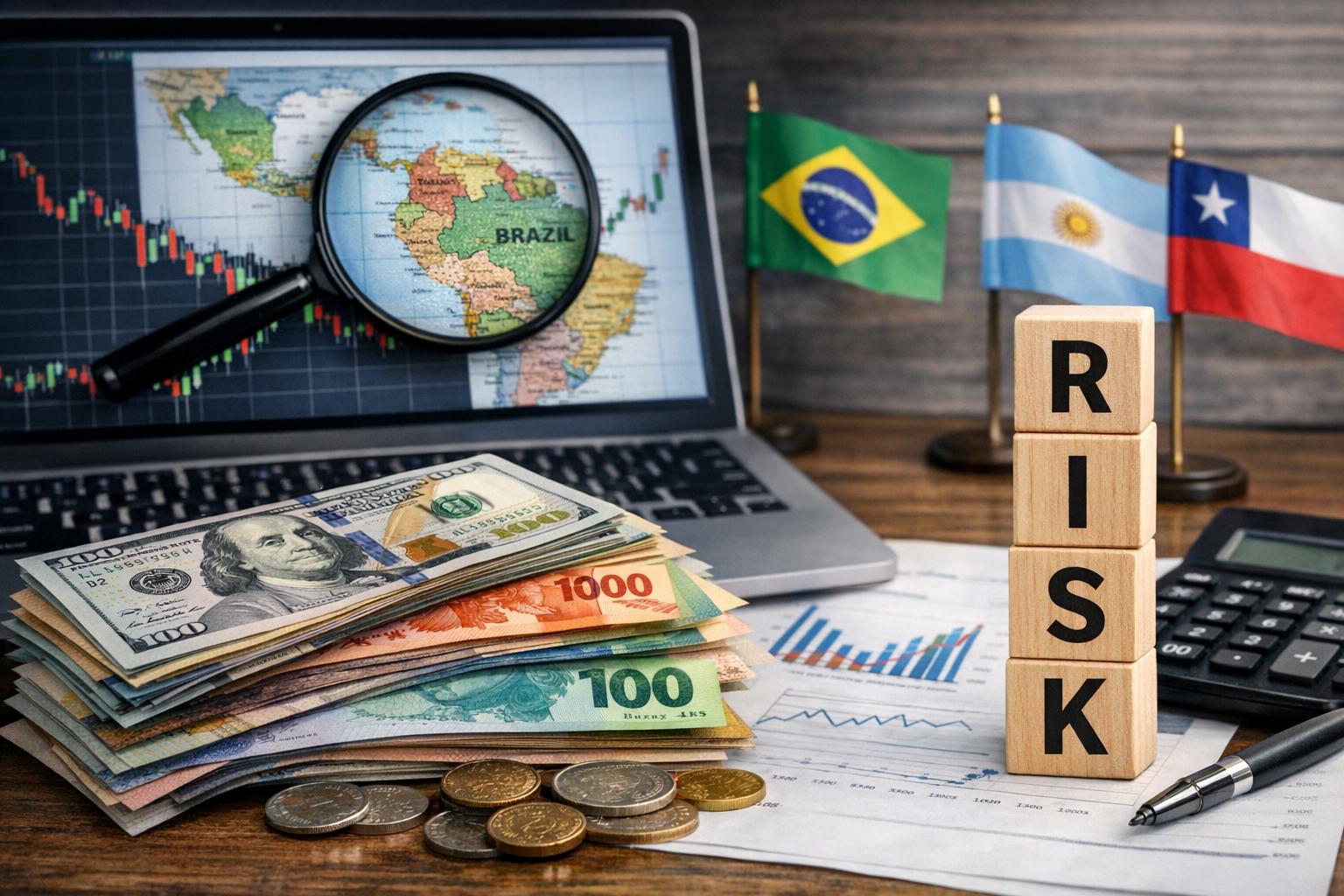
Currency Risk Management for Investing in Latin America
Introduction to Currency Risk in Latin American Investments
Investing in Latin America offers exposure to expanding consumer markets, commodity production, infrastructure development, and financial services growth. However, investors allocating capital to the region must carefully evaluate currency risk, also known as foreign exchange (FX) risk. Currency risk arises when the value of investment returns fluctuates due to changes in exchange rates between the investor’s base currency and the currency of the target country.
Latin America presents complex currency dynamics shaped by commodity cycles, external debt exposure, fiscal policy discipline, political shifts, and global interest rate movements. Countries such as Brazil, Mexico, Chile, Colombia, Peru, and Argentina each maintain distinct monetary regimes, financial structures, and institutional strengths. Understanding how to measure and manage these risks is critical for preserving portfolio stability and optimizing long-term returns.
For foreign investors, currency risk may at times outweigh local asset price movements. A strong equity rally in local currency terms can be partially or completely offset by depreciation of that currency relative to the investor’s home currency. Similarly, stable bond returns domestically may translate into negative total returns once converted back into dollars or euros. As a result, currency exposure must be evaluated as a central component of portfolio construction rather than as a secondary consideration.
Nature of Currency Risk in Latin America
Currency risk in Latin America reflects both domestic economic conditions and broader international capital flow cycles. While each country operates under its own policy framework, the region shares structural characteristics typical of emerging markets, including sensitivity to external financing conditions, reliance on commodity exports in several economies, and varying levels of institutional development.
Commodity Dependence
A significant driver of exchange rate volatility in Latin America is commodity dependence. Brazil exports iron ore, soybeans, and oil. Chile is one of the world’s largest copper producers. Colombia and Mexico rely heavily on oil exports, while Peru benefits from copper and precious metals production.
When global commodity prices rise, export revenues increase, trade balances improve, and foreign exchange inflows strengthen local currencies. Conversely, commodity downturns may pressure fiscal accounts and current account balances, contributing to depreciation. This sensitivity creates a pro-cyclical pattern in certain currencies, linking them closely to global industrial demand and Chinese economic growth trends.
The correlation between commodities and currency values is not constant, but it often intensifies during global economic shifts. Investors must evaluate whether currency appreciation is driven by structural reform and productivity gains or primarily by favorable commodity pricing cycles.
Interest Rate Differentials
Interest rate differentials between Latin American economies and developed markets play a central role in determining capital flows. Higher nominal interest rates may attract international investors seeking yield, particularly in a low-rate global environment. This dynamic can support currencies in the short to medium term.
However, interest rate advantages can reverse quickly. When the United States Federal Reserve or other major central banks tighten monetary policy, capital may flow back into developed markets. The resulting appreciation of the U.S. dollar often places downward pressure on emerging market currencies. Latin American central banks must therefore balance inflation control, domestic growth objectives, and exchange rate stability.
Carry trade strategies, where investors borrow in low-yield currencies and invest in higher-yielding ones, add further volatility. While profitable in stable conditions, these trades may unwind rapidly during periods of market stress, accelerating currency depreciation.
Political and Institutional Risk
Political developments significantly influence currency trajectories. Electoral cycles, fiscal reforms, changes in social spending, pension overhauls, and constitutional amendments can alter investor perception of risk. Countries with established inflation-targeting regimes and credible fiscal rules typically experience more measured currency reactions to political change.
Institutional strength—including central bank independence, rule of law, and transparency—contributes to reduced exchange rate volatility. Where policy credibility is weaker or fiscal imbalances are pronounced, currencies may react more sharply to economic data releases or political events.
External Debt Exposure
External debt denominated in foreign currencies, particularly U.S. dollars, remains a structural vulnerability in some Latin American economies. When domestic currencies depreciate, the cost of servicing dollar-denominated obligations increases in local currency terms. This dynamic may worsen fiscal balances and corporate leverage ratios.
The feedback loop between depreciation and debt sustainability can amplify market stress. Investors should review sovereign debt profiles, corporate borrowing structures, and maturity schedules to assess potential currency pressure points during global downturns.
Forms of Currency Exposure
Currency exposure in Latin American investments manifests in several distinct forms, each affecting investors differently depending on asset class and investment structure.
Transaction Exposure
Transaction exposure arises from contractual cash flows denominated in foreign currency. A U.S.-based investor purchasing Mexican government bonds denominated in pesos must convert dollars into pesos at the time of purchase and later reconvert interest and principal payments into dollars. Any exchange rate movement during that holding period influences realized returns.
Transaction exposure is typically most visible in portfolio investments with defined entry and exit dates. It can be hedged directly through derivatives that match anticipated cash flow schedules.
Translation Exposure
Translation exposure affects multinational firms that consolidate financial statements across multiple jurisdictions. Revenues generated in Brazilian reais or Chilean pesos are translated into the parent company’s reporting currency. Exchange rate shifts can affect reported earnings, asset valuations, and equity metrics.
For equity investors, understanding translation exposure is important when evaluating multinational corporations with operations across Latin America. Even if operational performance remains stable in local terms, currency movements may distort consolidated financial results.
Economic Exposure
Economic exposure reflects the long-term impact of exchange rate changes on a company’s competitive position. Persistent depreciation can make exporting sectors more competitive internationally, while appreciation may pressure domestic producers competing with imports.
For example, a sustained depreciation of the Colombian peso may increase the global competitiveness of agricultural exports but raise costs for firms reliant on imported capital goods. This broader structural influence extends beyond accounting effects and shapes corporate strategy, wage dynamics, and investment planning.
Assessing Currency Risk Before Investing
A structured analytical approach is essential before allocating capital to Latin American markets.
Macroeconomic Indicators
Key macroeconomic variables include inflation rates, fiscal balances, current account positions, and debt-to-GDP ratios. Persistent fiscal deficits financed by external borrowing may increase reliance on foreign capital. Rising inflation, particularly if unanchored by credible policy responses, often signals depreciation risk.
Current account deficits require financing through capital inflows. If global conditions tighten, currencies in deficit countries may face adjustment pressure. Conversely, current account surpluses supported by export competitiveness may provide resilience.
Central Bank Credibility
Independent central banks operating under transparent inflation-targeting frameworks typically anchor inflation expectations more effectively. Brazil, Mexico, Chile, Colombia, and Peru generally maintain inflation-targeting systems, though policy effectiveness can vary over time.
Central bank communication, reserve adequacy, and commitment to policy consistency influence investor confidence. Abrupt policy shifts or politically driven interventions can introduce additional uncertainty.
Foreign Exchange Reserves
Foreign exchange reserves serve as a buffer against external shocks. Adequate reserve coverage relative to short-term external debt and import requirements enhances a country’s ability to manage volatility. While reserves do not prevent depreciation in a free-floating regime, they may reduce disorderly market conditions.
Historical Volatility and Correlation
Quantitative analysis complements macroeconomic assessment. Measuring historical standard deviation of currency movements helps estimate expected volatility. Correlation analysis between currency returns and global risk indicators, such as equity indices or commodity benchmarks, provides insight into diversification potential.
Institutional investors frequently incorporate value-at-risk (VaR) measures, drawdown analysis, and stress simulations into portfolio models. These tools do not predict future exchange rates but frame potential loss ranges under defined probabilities.
Hedging Strategies for Currency Risk
Currency hedging aims to reduce variability in returns caused by exchange rate fluctuations. The choice of instrument depends on investment horizon, liquidity needs, and cost considerations.
Forward Contracts
Forward contracts allow investors to lock in an exchange rate for a specific future date. They are widely used for hedging local currency bond holdings or equity portfolios. By fixing the future conversion rate, investors eliminate uncertainty regarding currency impact on known cash flows.
However, forward pricing incorporates interest rate differentials, meaning hedging costs can be significant when local rates exceed those of the base currency. Investors must consider how this cost affects expected returns.
Futures Contracts
Currency futures operate similarly to forwards but trade on regulated exchanges with standardized contract sizes and maturity dates. They offer pricing transparency and central clearing, reducing counterparty risk. Futures may not perfectly match exposure amounts, requiring careful position sizing.
Currency Options
Options provide asymmetric protection. Purchasing a put option on a local currency establishes a minimum exchange rate while allowing participation in appreciation. This flexibility comes at the cost of an upfront premium. Option pricing depends on implied volatility, time to maturity, and interest rate differentials.
Options are particularly useful in environments with elevated political uncertainty or during election cycles when depreciation risk skews to one side.
Cross-Currency Swaps
Cross-currency swaps involve exchanging principal and interest payments in different currencies over extended periods. Corporations financing infrastructure projects or sovereign borrowers managing debt profiles often use swaps to rebalance currency exposure.
Natural Hedging
Natural hedging aligns revenue and expense streams in the same currency, reducing net exposure. Corporations operating in Latin America may finance local projects with local-currency debt, thereby minimizing mismatch risk between earnings and obligations.
Investment Vehicle Considerations
The design of the investment vehicle influences currency exposure significantly.
Local Currency Bonds vs. Hard Currency Bonds
Local currency sovereign bonds offer potentially higher yields but expose investors fully to exchange rate risk. Dollar-denominated bonds issued by Latin American governments transfer currency risk to the issuer. While this reduces FX volatility for investors, credit risk remains and yields may be lower.
Equities
Equity returns incorporate both market performance and currency fluctuations. Export-oriented firms may benefit from depreciation, partially offsetting losses from translation effects. Firms dependent on imported inputs may experience margin pressure during currency weakness.
Exchange-Traded Funds
ETFs provide diversified regional exposure but vary in hedging practices. Unhedged funds pass currency fluctuations directly to investors. Hedged share classes aim to neutralize currency effects, though their methodology and rebalancing frequency influence effectiveness.
Strategic vs. Tactical Hedging Approaches
Strategic hedging maintains a consistent hedge ratio, prioritizing volatility control and long-term predictability. Tactical hedging adjusts exposure based on valuation signals, macroeconomic expectations, or political analysis.
Strategic frameworks appeal to long-term institutional investors seeking stability. Tactical approaches may suit investors with in-house macro research capabilities willing to adjust exposures dynamically. Each method requires governance policies defining risk tolerance and decision authority.
Cost Considerations in Hedging
Hedging costs stem from interest rate differentials, bid-ask spreads, brokerage fees, collateral requirements, and option premiums. In environments where Latin American policy rates are substantially higher than rates in developed markets, forward contracts may impose a persistent negative carry.
Over extended holding periods, these costs can materially affect compounded returns. A clear cost-benefit analysis should compare expected volatility reduction with incremental expenses.
Diversification Across Countries and Currencies
Diversification across multiple Latin American countries can mitigate single-country currency shocks. Mexico’s integration with the U.S. economy differs from Brazil’s commodity orientation or Chile’s copper reliance. Currency drivers vary accordingly.
However, systemic global shocks, such as rapid dollar appreciation or global financial tightening, may reduce diversification benefits in the short term. Regional allocation strategies should therefore consider global risk sensitivity alongside country-specific fundamentals.
Impact of Global Financial Cycles
Latin American currencies often respond to changes in global liquidity conditions. Periods of expansive monetary policy in advanced economies can increase capital flows to emerging markets, strengthening regional currencies. Conversely, global tightening cycles or risk aversion episodes typically support the U.S. dollar and pressure emerging market exchange rates.
Monitoring U.S. Treasury yields, global inflation data, and credit spreads provides valuable context. While domestic reforms influence long-term currency performance, external financial cycles frequently dominate shorter-term fluctuations.
Inflation and Real Returns
Countries with persistently higher inflation than their trading partners tend to experience long-term currency depreciation. Nominal yields on local bonds may appear attractive, but real returns after adjusting for inflation and depreciation may be more modest.
Inflation-linked instruments adjust principal values for domestic price changes, reducing inflation risk but not eliminating exchange rate exposure. Investors must differentiate between local real returns and returns translated into their home currency.
Regulatory and Capital Controls
Regulatory environments influence capital mobility. In periods of stress, some governments have implemented temporary capital controls or foreign exchange restrictions. Such measures may limit liquidity or delay profit repatriation.
Understanding taxation rules, clearing systems, custody arrangements, and any historical precedents of capital restrictions enhances operational preparedness and risk assessment.
Risk Measurement Frameworks
Institutional investors integrate currency exposure into comprehensive portfolio risk systems. Value-at-risk models estimate potential losses over defined horizons and confidence intervals. Stress testing examines currency behavior under extreme scenarios, including sharp commodity declines or sovereign credit downgrades.
Scenario analysis may combine macroeconomic shocks, sudden capital outflows, and interest rate adjustments. Clear measurement frameworks guide allocation sizing, hedge ratios, and capital reserves.
Long-Term Perspective on Currency Volatility
Short-term currency movements are often influenced by sentiment, liquidity flows, and geopolitical developments. Long-term trajectories reflect productivity growth, fiscal discipline, demographic trends, and structural reform progress.
Investors with extended horizons may accept moderate currency volatility if macroeconomic fundamentals improve and institutions strengthen. Nevertheless, disciplined risk management remains necessary because exchange rate appreciation is not guaranteed even amid economic growth.
Conclusion
Currency risk is a central component of investing in Latin America. Exchange rates respond to commodity cycles, interest rate differentials, fiscal sustainability, political developments, and global liquidity conditions. These variables interact to create both opportunity and volatility.
Through structured macroeconomic analysis, quantitative risk assessment, and disciplined hedging strategies, investors can manage currency exposure systematically. Forward contracts, options, swaps, natural hedging, and diversified allocation each serve distinct roles within a comprehensive framework.
Currency risk cannot be entirely eliminated, but it can be measured, priced, and integrated into portfolio design. A consistent, research-driven approach enhances the capacity to navigate Latin America’s dynamic financial landscape while maintaining alignment with long-term investment objectives.
About the Author