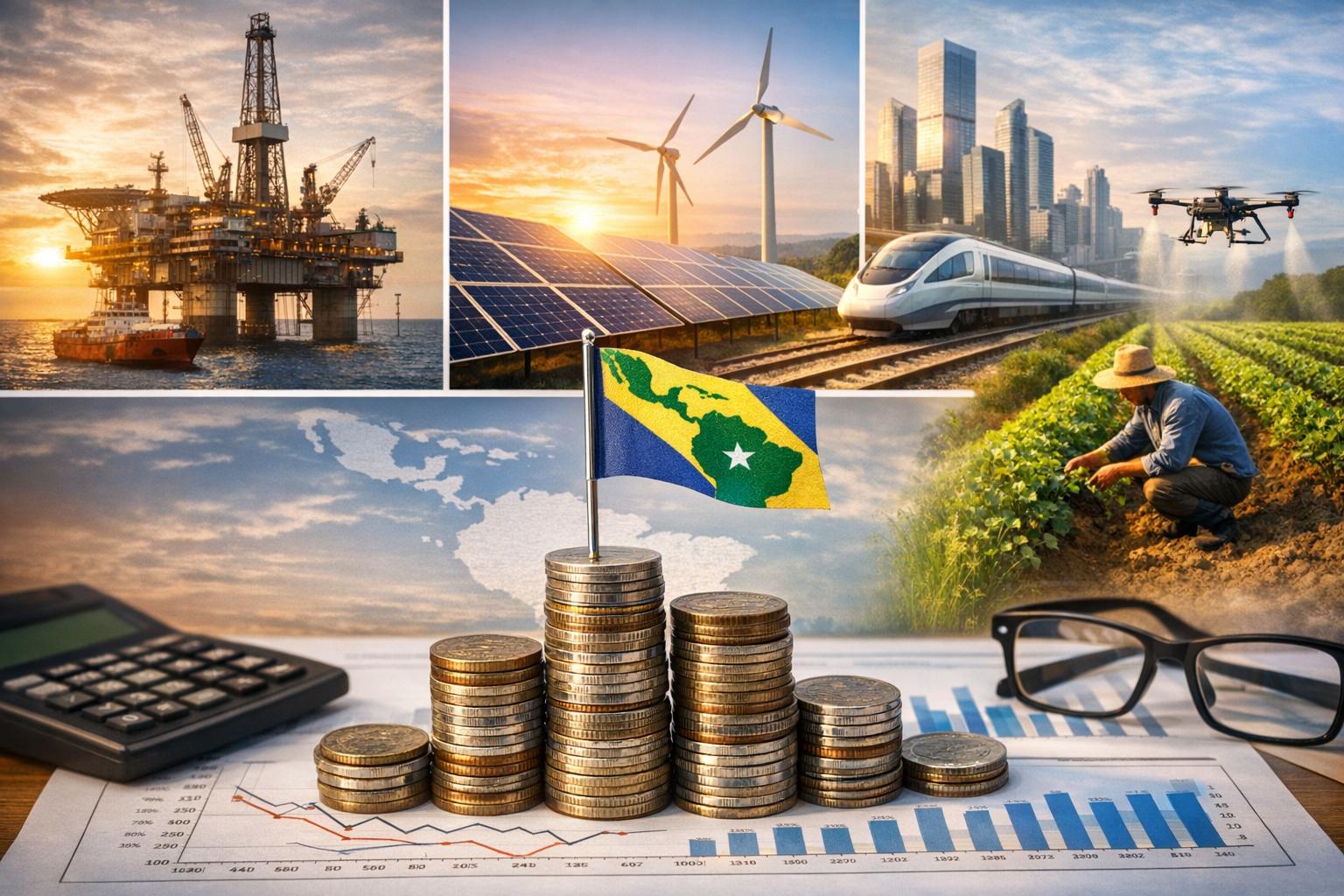
The Best Sectors to Invest in Across Latin America in 2026
Macroeconomic Context for Latin America in 2026
Latin America enters 2026 in a more stable macroeconomic position than in the early years of the decade. Inflation, which accelerated sharply during 2022 and 2023 due to global supply disruptions, currency depreciation, and elevated commodity prices, has moderated in several major economies. Brazil, Mexico, Chile, and Colombia have seen price pressures ease toward their respective central bank target ranges. The credibility of monetary authorities, reinforced by early and sometimes aggressive tightening cycles, has strengthened policy transmission mechanisms and restored investor confidence in local currency assets.
With inflation expectations better anchored, central banks in parts of the region have begun gradual easing cycles. Lower benchmark interest rates support domestic credit expansion, corporate refinancing, and household consumption. The pace of easing varies by country, depending on fiscal conditions, exchange rate stability, and exposure to external shocks. Monetary policy remains data-dependent, particularly given sensitivity to United States Federal Reserve decisions and global capital flows.
Fiscal consolidation has progressed unevenly. Brazil and Colombia have implemented revised fiscal frameworks aimed at stabilizing public debt trajectories, while Chile has adjusted expenditure growth to address structural deficits. Mexico maintains comparatively moderate public debt levels relative to GDP, though contingent liabilities linked to state-owned enterprises remain under review by markets. Argentina continues to navigate macroeconomic adjustment, and its stabilization efforts influence broader regional risk perception.
External balances also shape the outlook. Commodity exporters benefit from sustained global demand for minerals, agricultural goods, and energy products, though price volatility remains a structural feature. Current account positions differ across countries, with some maintaining manageable deficits supported by foreign direct investment inflows. The accumulation of international reserves in select economies provides an additional buffer against external liquidity shocks.
Global geopolitical dynamics further reinforce Latin America’s strategic position. The restructuring of global supply chains, strategic decoupling between major powers, and the acceleration of the energy transition have increased demand for the region’s natural resources and manufacturing capacity. Demographic trends, urbanization, and digital adoption strengthen domestic consumption prospects. Within this economic environment, sector-specific analysis becomes central to identifying medium- and long-term investment opportunities.
Renewable Energy and Energy Transition Infrastructure
The renewable energy sector stands out as a structural growth area across Latin America. The region’s geographic characteristics offer substantial comparative advantages. High solar irradiation in northern Chile and parts of Mexico, consistent wind patterns in northeastern Brazil, and extensive hydroelectric capacity in Brazil and Colombia create a diversified renewable base. Policymakers increasingly frame renewable expansion not only as a climate commitment but also as a matter of energy security and industrial competitiveness.
Brazil remains a regional leader in installed renewable capacity. Hydropower continues to account for a significant share of generation, complemented by rapid growth in wind and utility-scale solar projects. Transmission investments are expanding to connect renewable-rich regions with industrial centers in the southeast. Private capital participation through auctions and long-term power purchase agreements remains a defining characteristic of the Brazilian model.
Chile’s energy transition is closely tied to its ambition to become a major exporter of green hydrogen. Abundant solar and wind resources enable low-cost renewable generation, which in turn supports electrolyzer-based hydrogen production. By 2026, early-stage projects continue to move through feasibility and financing phases, with export-oriented infrastructure under development in port areas. Regulatory clarity and long-term policy frameworks are central to sustaining investor participation.
Mexico presents a more complex landscape. While regulatory adjustments earlier in the decade affected investor sentiment, the country’s industrial integration with North America supports electricity demand growth, particularly from manufacturing clusters in the north. Distributed generation, rooftop solar installations, and private corporate power contracts remain active subsegments even amid policy recalibration.
Beyond generation assets, energy transition infrastructure represents a substantial investment theme. Grid modernization, smart metering systems, battery storage installations, and digital management platforms are increasingly necessary to maintain stability as variable renewable penetration rises. Companies engaged in engineering, grid operation software, high-voltage equipment manufacturing, and battery supply chains are positioned to benefit from sustained capital expenditures.
Electrification trends extend into transport. Urban authorities in Brazil, Mexico, and Colombia are incorporating electric buses into public fleets. Private sector investments in charging networks and logistics fleet electrification are gradually expanding. The long asset life of infrastructure projects provides visibility for long-term investors, though currency management and regulatory risk assessment remain essential.
Critical Minerals and Mining Modernization
Latin America occupies a central role in the supply of critical minerals required for global decarbonization and digitalization. Copper, lithium, nickel, and rare earth elements are integral to renewable power systems, batteries, and electric vehicles. The concentration of reserves in specific countries creates both opportunity and exposure to local regulatory frameworks.
Chile and Peru dominate global copper supply. Copper’s conductivity makes it indispensable for transmission lines, electric motors, and renewable installations. Structural deficits projected in global copper markets support long-term investment planning, although cyclical price fluctuations remain part of the industry’s risk profile. New exploration and brownfield expansion projects depend on environmental approvals, water management strategies, and community engagement programs.
The “Lithium Triangle,” composed of Chile, Argentina, and Bolivia, accounts for a large portion of global lithium resources. Argentina has advanced project pipelines with relatively open investment policies, attracting multinational mining firms. Chile is refining its lithium governance model, balancing state participation with private-sector efficiency. Bolivia’s resource potential remains significant, though development timelines are more uncertain.
Value chain development is gaining importance. Rather than exporting raw lithium carbonate or concentrate, some governments aim to encourage local refinement into battery-grade materials. While full battery manufacturing ecosystems remain limited, incremental movement up the value chain reflects industrial policy ambitions. Investors assess infrastructure availability, power costs, and trade agreements when evaluating downstream integration potential.
Technological modernization in mining is another prominent theme. Automation in drilling and hauling, remote operations centers, water recycling systems, and renewable-powered processing facilities enhance productivity and reduce environmental impact. Service providers offering digital platforms, environmental monitoring solutions, and efficiency-enhancing technologies gain indirect exposure to commodity expansion with diversified client bases.
Social license to operate remains a central consideration. Transparent community engagement, environmental mitigation, and compliance with evolving ESG standards influence project feasibility. Mining jurisdictions with predictable permitting processes and stable royalty regimes tend to command valuation premiums.
Agribusiness and Food Processing
The agribusiness sector continues to underpin regional export performance. Latin America’s climatic diversity and availability of arable land support high agricultural output. Brazil’s scale is particularly significant, ranking among leading global producers of soybeans, corn, beef, poultry, sugar, and coffee. Argentina, Paraguay, and Uruguay contribute additional grain and livestock exports, while Mexico specializes in fruits and vegetables destined for the North American market.
Global population growth and dietary transitions in emerging markets sustain demand for protein and grain-based feed. In 2026, productivity improvements rather than land expansion increasingly define growth strategies. Environmental scrutiny and deforestation controls reinforce the need for sustainable intensification.
Precision agriculture technologies are expanding. Satellite imagery, yield analytics, automated irrigation systems, and genetically optimized seeds contribute to efficiency gains. Agri-input companies, farm equipment manufacturers, and digital farm management platforms benefit from this modernization process. Financial institutions providing crop insurance and structured trade finance solutions also play an integral role.
Food processing represents a transition from commodity export toward value-added production. Milling, meat processing, biofuel refinement, and packaged food manufacturing capture higher margins and reduce exposure to raw commodity price swings. Investments in port terminals, rail corridors, and storage facilities improve logistics competitiveness and reduce post-harvest losses.
Climate variability introduces ongoing risk. El Niño and La Niña patterns influence rainfall distribution, affecting crop yields. Geographic diversification and the adoption of drought-resistant seed varieties constitute risk mitigation strategies for producers and investors alike.
Manufacturing and Nearshoring in Mexico and Central America
The structural shift toward nearshoring remains one of the most consequential trends influencing the region. Companies seeking supply chain resilience and reduced geopolitical exposure are relocating or expanding operations closer to the United States market. Mexico is central to this transformation.
Participation in the United States-Mexico-Canada Agreement (USMCA) ensures tariff advantages and integrated rules of origin. Automotive production, electronics assembly, aerospace components, and medical devices represent core industrial segments. Industrial parks in northern states such as Nuevo León, Chihuahua, and Coahuila continue to attract foreign direct investment.
Industrial real estate demand has remained elevated into 2026. Developers respond with new warehouse construction, cross-docking facilities, and logistics hubs. Rail links and highway upgrades facilitate cross-border trade efficiency. The multiplier effect on local services, housing demand, and financial services reinforces regional economic clusters.
Central American economies, though smaller in scale, participate in this manufacturing reconfiguration. Costa Rica’s medical device cluster demonstrates the viability of specialized export-oriented production. The Dominican Republic and Guatemala leverage free trade zones to attract light manufacturing and textile operations.
Infrastructure constraints, energy reliability, and workforce training remain variables influencing long-term competitiveness. Nonetheless, structural integration with the U.S. market provides a durable foundation for sustained industrial activity.
Financial Services and Digital Banking
The financial services sector illustrates the combination of maturity and expansion potential characteristic of Latin America. Traditional banks in Brazil, Mexico, and Chile operate with relatively sophisticated regulatory oversight and stable capitalization levels. However, large segments of the population remain underbanked, particularly in rural areas and informal sectors.
Digital banking platforms address this gap. Brazil’s instant payment system and open finance regulations have fostered innovation and competition. Mexico’s fintech ecosystem supports electronic wallets, remittance platforms, and small business lending solutions. Cross-border scalability has emerged as a defining feature of successful digital banks.
As interest rates moderate, credit growth conditions improve. Mortgage lending, consumer finance, and SME credit contribute to economic expansion. Asset management and pension fund industries continue gradual development, though capital market depth varies across jurisdictions.
Risk assessment remains critical. Regulatory divergence, evolving data protection standards, and capital adequacy requirements influence profitability. Currency mismatches in dollarized lending portfolios also warrant attention. Nonetheless, financial inclusion trends and digital adoption underpin long-term sector relevance.
Infrastructure and Public-Private Partnerships
Infrastructure development addresses structural productivity constraints. Governments increasingly rely on public-private partnerships to finance highways, airports, ports, sanitation systems, and urban transit networks. Well-designed concession frameworks provide multi-decade revenue streams linked to usage fees or availability payments.
Brazil’s concession model includes toll roads, airport management contracts, and water sanitation projects. Colombia and Peru maintain pipelines of transport and logistics projects supported by multilateral lenders. Chile’s established concession system continues to attract institutional investors seeking stable yields.
Digital infrastructure expansion complements physical asset development. Fiber-optic networks, 5G deployment, and regional data centers respond to rising data consumption and cloud computing demand. Countries with reliable electricity supply and competitive energy costs draw attention as data hosting hubs.
Currency exposure represents a central risk factor, particularly when project revenues are denominated in local currencies while financing is sourced internationally. Political transitions may also influence concession renegotiation processes. Thorough legal structuring and risk allocation mechanisms are essential components of successful infrastructure investment.
Oil, Gas, and Transitional Energy
Oil and gas continue to contribute materially to export revenues and fiscal accounts in several countries. Brazil’s offshore pre-salt reserves remain among the most productive globally. Technological expertise and regulatory auctions sustain international participation. Production growth contributes to trade balance resilience.
Argentina’s Vaca Muerta shale formation offers unconventional resource potential. Infrastructure buildout, including pipelines and liquefaction capacity, shapes the feasibility of expanding exports. Mexico’s hydrocarbon sector retains resource depth, though policy direction influences private capital involvement.
Natural gas occupies a transitional role in power generation and industrial feedstock supply. Integration of emissions reduction technologies and methane management practices aligns hydrocarbon operations with evolving climate standards. Commodity price volatility remains inherent, requiring financial discipline and cost efficiency from operators.
Tourism, Hospitality, and Urban Development
Tourism activity in Mexico, the Caribbean, and parts of South America has broadly normalized. International arrivals support hotel occupancy rates and related services. Investment in airport expansions, cruise terminals, and mixed-use urban developments accompanies tourism growth. Secondary cities and eco-tourism destinations attract interest due to lower land costs and differentiated offerings.
Exchange rate competitiveness influences visitor flows. Security conditions and infrastructure quality shape regional variations in performance. Professional management and adherence to sustainability standards increasingly define project viability and financing access.
Technology Services and Outsourcing
The expansion of technology services and outsourcing reflects the region’s human capital development. Colombia, Costa Rica, Uruguay, and parts of Argentina cultivate software engineering, IT support, and shared service center capabilities. Alignment with North American time zones and cultural affinity supports cross-border integration.
Demand for cybersecurity, cloud infrastructure management, and artificial intelligence implementation encourages local specialization. Compared with capital-intensive industries, technology services require lower fixed investment while offering scalable revenue models. Education systems, digital connectivity, and intellectual property protection remain enabling factors.
Conclusion: Sector Selection and Risk Considerations
Latin America in 2026 presents a multifaceted investment landscape shaped by macroeconomic stabilization and structural transformation. Renewable energy expansion, critical mineral extraction, agribusiness modernization, and nearshoring-driven manufacturing form the backbone of regional growth themes. Financial innovation, infrastructure development, and technology services reinforce these sectors by supporting domestic demand and productivity gains.
Country differentiation remains essential. Regulatory consistency, political stability, currency management, and institutional strength vary across jurisdictions. Commodity exposure introduces cyclical considerations, while climate variability adds operational complexity in agriculture and energy.
Balanced portfolios often combine export-oriented resource sectors with domestic demand-driven industries. Long-term success depends on aligning sector exposure with macroeconomic conditions, regulatory frameworks, and global structural trends. Through disciplined due diligence and diversified allocation, investors can engage constructively with the region’s evolving economic landscape in 2026 and beyond.
About the Author